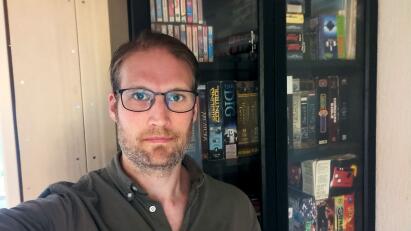
Name: Eric Lavesson
From: "Currently living in the countryside in central Skåne (south Sweden), just outside a small village near Eslöv"
Age: 42
Interests: "Too many probably, but mainly gaming, programming, working on old rusty cars for fun, running/training/fitness and just spending time with my wife and son"
Favorite games: "Sekiro, from the modern era, and Super Metroid, from the not-so-modern era, both of those influences might show in our current project"
Profession: "Founder of and developer at Decemberborn Interactive, an indie game studio based in Helsingborg that released the game Cathedral and is currently working on Cathedral: Crow’s Curse"
Eric Lavesson
What is your background?
"I initially studied math and physics at university, then figured I should apply it to something. I went into teaching and earned a master's in education. At roughly the same time I also did a B.Sc with a major in software engineering. I couldn't really make up my mind on what to work with. I worked as a math/physics teacher for about three years before I went on to work as a consultant at a software firm, which through a few twists and turns, led to me forming Decemberborn and making games."
"Games were always driving me, but I ended up doing it as a hobby only - I didn’t start working in the industry until 2016 when I formed Decemberborn."
Why did you start working in the games industry?
"I grew up with game consoles such as the NES and the Sega Master System, plus various computers (Commodores and Ataris mostly). I started programming somewhere around the age of 9-10 in the early 90s, and at that time, it was BASIC on an Atari 600XL. It was still games that drew me in from the very start though, and I had a book (I still have it!) with example programs that you could type in. Initially I did a lot of very simple text adventures.
From there, I moved onto STOS on the Atari ST (a programming language specifically for games) and where I learned about sprites, movement and input and so on. After this, I dabbled in some 68k assembler before getting my first PC, where I made a bunch of small games with Microsoft QuickBasic. From there, I went on to learn C and C++ and a few other languages. Games were always driving me, but I ended up doing it as a hobby only - I didn’t start working in the industry until 2016 when I formed Decemberborn.
I got interested in math and physics somewhere in my late teens/early 20s and got derailed from programming with the idea that I shouldn’t work with my passion, out of being afraid that it would ruin it (it didn’t, by the way). Long story short, after studying to be a teacher and then teaching math and physics for a few years at a Swedish high school, I decided to go back to programming full-time. Finding work within the game industry wasn’t easy, but since I enjoyed programming overall, I ended up becoming a hybrid-kind-of consultant that taught courses on software development to companies, as well as doing software consultancy too (i.e. actually writing code).
All of this is part of a very long journey spanning over a decade, and I could say a lot more about it. But what's important is that this whole journey led me to meeting some great people, who I’ve started a couple of companies with, Decemberborn being one of them."
How has working in the industry been for you?
"It has been interesting to say the least. I got into the industry with the mindset of a (non-game) software developer. I had a coding mindset, and it even started with me saying “I want to make a game engine” rather than “I want to make a game”. Even though I ended up actually making a game in that engine, I didn’t think about marketing, or which platforms to port to, or who to reach out to. It has been a learning experience all the way through. Essentially I decided to make a game, ran into some great people and said 'it can’t be THAT difficult, can it?'.
Turns out that it is, and releasing that first game taught us a lot of hard-earned lessons. Now that we’re working on our second game, we have a way more relaxed mindset. I think we’ve learned to stress less over arbitrary deadlines, we’ve started to make connections we didn’t have before, and we’ve understood the value in bringing in help in the areas where we know that we aren’t at our best (such as marketing and PR).
But essentially, at the very start, we dove into the deep end and didn’t really have a clue on how the industry worked. We’ve just been gathering knowledge ever since. And I do think that if you’re new to the industry, don’t worry too much about not understanding it quite yet - just make sure you take notes and learn along the way."
"I do think that if you’re new to the industry, don’t worry too much about not understanding it quite yet - just make sure you take notes and learn along the way."
What is a day in your work life like?
"It depends on what aspect of the game I’m working on. Right now, we’re working on a prequel to our previous title. This new game is called Cathedral: Crow’s Curse. While I don’t work full time everyday on it, I usually start my day by sitting down, drinking coffee and playing through our current demo in the making. I make small mental notes about what I like and don’t like. I then usually have one 'big' thing I work on - right now for instance, it’s implementing a kind of 'fog of war' in our in-game map, which presents a number of interesting problems to solve.
I usually have a couple of hours in the morning by myself, and if I’m really not feeling like working on that one big feature at that point, I might just grab something smaller. So I’ll check our Trello board and see what seems like a fun thing to solve, and then do that instead. There’s kind of a balance between keeping things fresh and interesting without straying away from the path that actually makes us a game.
After that, I usually drop my son off at preschool, and then either work from my home office, or from my office office, depending on what I’m doing. More often than not, I go into the actual office. I then proceed to writing code for a bunch of hours straight, hopefully (but not always) remembering to have lunch."
What’s best with your job?
"The creativeness. Being able to create stuff out of thin air has always been a fantastic feeling for me. When you start with an idea and think 'oh, how cool would this be' and then start working on it, only to see it all coming together - there’s no feeling like it."
How would you advise others that want a job like yours to pursue it?
"I’m still not sure what I did right and what I’ve done wrong. My journey has been anything but a straight path. I’m sure there are a thousand different, probably better, ways I could have ended up where I am today, but it all worked out regardless.
I don’t think you’ll need to follow a perfect plan to get where you want to be. I think if you have a goal and enough personal drive to get there, you’ll find your way. I think the important bit to remember is this: If you’ve released a game, no matter how large or small, simple or complex, long or short, then you’re part of the industry and you’ve already begun your journey."
The WeMakeGames interview series allow individuals in the games industry to tell their story - about their current work, how they got to where they are, and why they believe the games industry is such an enjoyable industry to work in. We move beyond programmers and level designers, to showcase the wide range of roles making up the studios creating some of the world’s best games – right here in south Sweden!